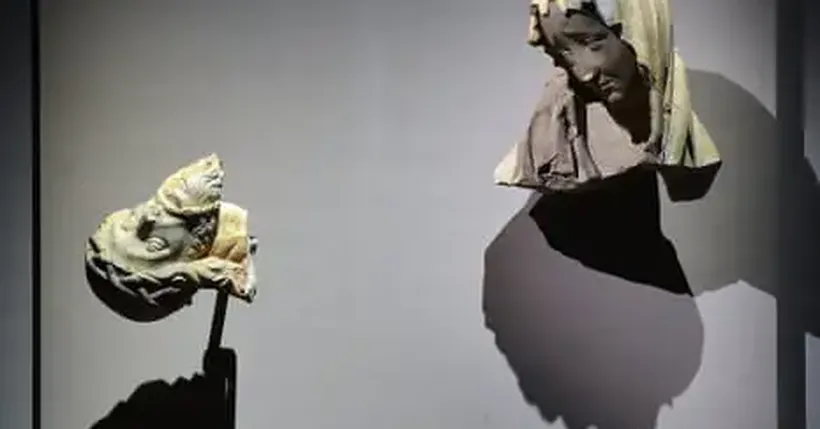
The nose of Cleopatra VII was supposed to have been so beautiful that it changed the course of history: if it had been shorter, French philosopher Blaise Pascal wrote, “the whole face of the earth would have changed”. A visit to the Palazzo Strozzi in Florence, however, will leave you convinced that Cleo’s conk was only the second most stunning feature to ever grace the face of an Egyptian pharaoh. Among the more than 80 objects on display at an exhibition that opened last week is an astonishingly lifelike sculpture showing off the lips of the 14th-century ruler Akhenaten: a seagull shape resting on a pillow of lush flesh, at once both stern and sensuous, almost uncomfortably kissable.
It was Thomas Aquinas who first came up with the theory that we perceive things to be beautiful when they are intact and whole, but the Akhenaten sculpture is so striking precisely because it has a major blemish. Like all the objects shown in Florence, it is only a fragment: a shard of polished limestone found in the dumps south of the Great Aten Temple in the city of el-Amarna, showing only the ruler’s nose and mouth.
“One of the unique qualities of fragments is that they focus your attention on details,” says CD Dickerson, an expert in Renaissance and baroque art. “You wouldn’t have considered the subtle way that the lip has been crisply carved in this stone if it had been part of a bigger statue with a bunch of other features. Fragments make you think about objects in a different way.”
Entitled Broken: The Power of Fragments, the show that Dickerson has co-curated for the Palazzo Strozzi and the National Gallery of Art in Washington DC explores why people throughout history have gone to great lengths to damage or destroy carefully crafted sculptures and statues. But along the way, it raises an even more intriguing question: why it is that some works of art have a more powerful emotional pull in a broken state than when whole?
Many of the objects shown here speak of fault lines in history. There is a decapitated lifesize statue of a kneeling prior from Romainmôtier in Switzerland, likely beheaded during the iconoclastic frenzy of the Protestant Reformation. The dismembered left foot and right hand of King Louis XIV is all that remains of an equestrian monument to the French royal after the revolution rolled across Paris’s Place Vendôme and put up a guillotine instead. Modernist sculptor Adolfo Wildt’s bust of Mussolini was adorned with a simple bullet through the forehead after the fall of the fascist regime.
The vandals were following an age-old tradition, says co-curator Andrew Sears. “Across the ancient world it was a common practice during regime changes or religious transformations to destroy images of the previous one because it was believed that the images contained some kind of life force of the ruler.”
In some cases, these defaced sculptures would stay on as a deterrent. “They were made to be displayed in that way,” says Sears. A 19AD bust representing Germanicus, heir to Tiberius, had its nose expertly hacked off, upper earlobes cut and forehead adorned with a cross by Christians who protested against the deification of Roman emperors. The past, we are reassured, was a foreign country with cruel rituals.
Broken starts to get more surprising and interesting where it explores brokenness as more than a result of historical fractures. A section called Sculpting the Fragment opens with an intriguing dogū figurine from ancient Japan. Little is known about these small, fired-clay statuettes with bulging coffee-bean eyes other than that they have been found in pieces all over burial sites in Japan.
Current research indicates that the function of dogū figurines may have been akin to modern-day birthday pinatas: smashed to celebrate not just the end of the old but also the start of the new. “It’s very clear that the culture was to make these sculptures to intentionally break them, and for communities to share pieces with each other,” says Dickerson. “Our contemporary perception of ancient cultures being more violent is not always accurate.”
Dickerson and Sears’ rummage through the darker corners of museum storage rooms has yielded little evidence of Aquinas’s equation of breakage with ugliness. Often, the opposite held true. From the early 15th-century Aztec capital of Tenochtitlan, they present a statue of a reclining figure that was intentionally decapitated, as part of a campaign to rebuild a temple. Modelling their approach on the ruinous state of their surroundings, the Mexica seem to have understood completion to be unattainable. A broken artwork was proper because it revealed the true state of the world.
We may think of the cult of ruined buildings and broken statues as an obsession of the Romantics, of the paintings of Caspar David Friedrich or the “colossal wreck” of Percy Shelley’s Ozymandias. But Dickerson says ruin lust was already embedded in the art and literature of the Renaissance from the 13th century onwards. One of the most striking displays in Florence is a Michelangelo terracotta model of a headless and armless woman. Dated around 1533, it looks damaged but isn’t. Instead, it was the Renaissance’s answer to a pair of pre-distressed grunge-wash jeans: recent technical analysis of the torso’s breakage points suggests Michelangelo deliberately sculpted a fragment, in homage to the awe-inspiring antiquities that were being excavated in Rome at the time.
The exhibition culminates with contemporary artistic takes on broken sculptures, such as a Louise Bourgeois’ foot in a leg brace and German artist Julius von Bismarck’s collapsable equestrian statue of his chancellor forebear, Otto. If that feels slightly self-restraining, it’s because the wholeness v brokenness divide is still everywhere in modern popular culture once you start looking for it. Here the far-right social media accounts with immaculate classical busts as avatars, the impeccably smooth aesthetics of the iPhone, the flattened masks of the “clean girl” makeup trend; there the rise of broken bodies on the big screen, from Mad Max’s one-armed Furiosa to cleft-lipped lead actors like Tom Burke and Franz Rogowski and Game of Thrones’ “cripples, bastards and broken things”.
Clearly, the answer to the question of whether there is a beauty in brokenness is not just one that captured ancient civilisations, but continues to be one of the central cultural dividing lines of our time.
Broken: The Power of the Fragment is at Palazzo Strozzi, Florence, 25 September 2026 until 24 January, and at the National Gallery of Art, Washington, from 13 March to 27 June 2027
Other News

Burnham Vows to Seek New ‘Long-Term’ Relationship with EU in Emotional Labour Conference Speech

Estonia Blames Russia for Arson Attack on Drone Maker Supplying Ukraine
Armless Fun: Why Sculpture Can Have Far More Power and Be Much More Sensuous When It’s Broken