Cecilia Vicuña was 24 when she first arrived in London. She had come from Santiago on a British Council scholarship to study at the Slade School of Art, and her stay was supposed to be so brief that she didn’t even unpack her suitcase.
Then, in September 1973, General Augusto Pinochet’s military coup overthrew Chile’s democratically elected president, Salvador Allende. Vicuña was one of a handful of Chilean students in London immediately expelled from their universities and expected to leave Britain. At a Home Office hearing, her pro-bono lawyers argued that she would be killed if she returned to Chile, and showed the judges her recently published art and poetry book, Saborami, which documented the aftermath of the coup. The judges granted her asylum.
“It’s really one of the main stories of my life,” Vicuña says now. “How my poetry came to protect my wellbeing.”
We meet on Zoom, with Vicuña in her apartment in New York, where she has lived since 1980. Wearing a knitted hat, she speaks softly and sagely, like a shaman offering advice – small and fragile, but with big, existential ideas about life and art.
More than half a century since her arrival in London, Vicuña, now 78 and one of Latin America’s most renowned artists, poets and feminist activists, is returning – specifically to Stepney Green, where she lived as a young artist – for her first major UK exhibition, at the Whitechapel Gallery. She has mixed feelings. “In a way, I’m going back to relieve my original experience,” she says.
The London Vicuña encountered in the 1970s was very different from the image of “swinging London” exported around the world. “When you walked down the streets, people were extremely poor,” she says. “People had to put a penny to heat their little apartments. There was a feeling of sadness, of not being able to realise one’s full potential.”
But she began meeting exiles from failed revolutions across Africa, the Middle East, Greece and Latin America, found a thriving art community, and published her first book in London after it had been censored in Chile. “I grew to love it,” she says. “But I also understood that true creative energy was on the other side of the continent.”
The new exhibition, Living Threads, brings together six decades of Vicuña’s work across painting, textile, photography, installation and film. It also returns to her political life as a young artist speaking at trade union gatherings on the top floor of English pubs. A room is dedicated to Artists for Democracy, which Vicuña co-founded in 1974 with Guy Brett, David Medalla and John Dugger in solidarity with Chile and other liberation struggles worldwide, bringing together never-before-seen documents, photographs and printed materials.
“There have been a few attempts to tell this story without my presence,” she says. “The story has been told as if I was a visitor to the organisation.”
Her involvement began after artist Conrad Atkinson invited her to an ICA discussion about artists’ rights and sales. Shocked that people were discussing money while artists were being killed in Chile, Vicuña stood up to speak. Brett, Medalla and Dugger, sitting at the back, sent her a note afterwards. “I proposed that we should found an organisation for democracy,” she says.
“England was the first country to acknowledge Pinochet as the new leader of Chile,” she adds. “This violent overthrow of democratic government was celebrated by Britain.” Yet the same country had granted her the legal protection to stay: “The place where the defence of the law was powerful enough to grant me that.”
The exhibition also brings back a painful part of that period: the work Vicuña lost. During her exile, she left pieces with friends in London, Chile and Bogotá; one trunk contained 400 sculptures, eventually thrown away.
“I was so devalued as a person, as an artist,” she says. “To be a dark little South American woman, even in Latin America, is to be in a position of pain, disrespect and inappreciation.” Some have since been recreated from memory and photographs – not reconstruction, she says, but something closer to reincarnation. “It’s the stories and images that want to live again.”
That idea of disappearance runs through the two forms Vicuña is best known for. She began making what she calls precarios in the 1960s from sticks, feathers, leaves, stones, bones and debris – deliberately fragile, impermanent works, a response to standing as a 17-year-old on a Chilean beach, in the shadow of an oil refinery built over an ancestral burial ground, suddenly aware of the relationship between sea, wind and objects. The only surviving precario from her London years is in the show.
“To preserve and disappear are not opposite things,” she says. “Awareness of disappearance is what needs to be preserved. It’s the belief that life itself is poetry, and poetry is life. Disappearance is regeneration.”
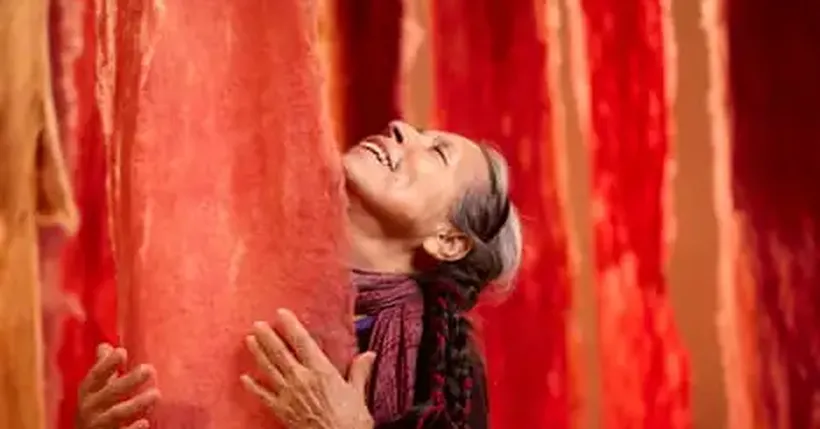
Her quipus, meanwhile, are made from knotted and unspun fibre, drawing on an ancient Andean system of recording and communication. Vicuña has spent decades reimagining the form, including in Quipu Menstrual, a towering installation in deep red that will be shown at Whitechapel, alongside the new installation Ciudad Geométrica (Geometric City).
Her work has increasingly turned towards ecology. She has worked with water for more than 50 years, and describes the current situation in Chile as both devastating and potentially transformative.
“Latin America is the most destroyed of all continents, 95% of its biodiversity has been destroyed already, because people continue to vote for leaders who open the gates to this violent extraction. They call them resources, but it’s not resources. It’s life.” But she points to hope: “Reports show that young Chileans see their future as professional defenders of the land. That, to me, is the most beautiful sign that this shift is still possible.”
double quotation markI think, in truth, democracy was never really practiced in the west
The current shift to the right in Chile, she argues, doesn’t simply repeat 1973. Back then, she says, those seeking justice, democracy and freedom of expression were the majority and were “violently crushed by foreign intervention. Now, people are willingly choosing to be aligned with the forces that deny global warming and deny people’s rights, women’s rights, the rights of nature.”
I ask her if democracy has become more fragile? “I think, in truth, democracy was never really practiced in the west.” She points to Allende’s Chile as one example of participatory democracy, and argues that many indigenous societies offered earlier models that were destroyed by colonisation.
The internet, she adds, was another squandered chance: a tool for universal access to knowledge that became a place of surveillance and misinformation. “Each chance that the people of this planet have had to open up to the potential of democracy a destructive force comes in to stop it.”
She sees artificial intelligence through a similar lens. Her concern is that AI is controlled by private companies for profit, while governments have failed to regulate what she sees as an existential threat.
“Now AI has been trained to train itself, and as soon as that happens, it started to behave in a destructive way. Powerful people are saying the existential threat to humanity is a hoax. I have the feeling most people in the world don’t feel it’s a hoax at all. So where is the democratic will of this planet? Is it crushed or prevented?”
Vicuña has spent decades operating relatively under the radar before a burst of institutional recognition began with her inclusion in Documenta in 2017, aged 69 – she was the youngest artist in a group that included women in their 80s and 90s. “It was the event that changed my life,” she says. “My work was acknowledged for the first time as a work that had meaning and importance.” The museum told her visitors came looking for “the red thing” – her quipu. Since then she has won the Golden Lion for Lifetime Achievement at the Venice Biennale, received a Guggenheim survey, and completed a Tate Modern Turbine Hall commission.
That 2022 work, Brain Forest Quipu, featured huge mobiles of fraying wool, knotted rope and debris mudlarked from the Thames, an elegy to lost language and wilful destruction; the Guardian’s five-star review called it the most moving Turbine Hall commission in years.
She sees the greater visibility of women, and of Latin American, Asian and African artists, in major museums as a genuine shift – but remains cautious. “Will that translate to women being valued as equals? We will see.”
For now, she is returning to the neighbourhood where the young artist she once was became an exile and activist. The Whitechapel exhibition brings together works that survived, works that disappeared, and works that have been remade. “I do hope it will be healing,” she says.
Cecilia Vicuña: Living Threads is at the Whitechapel Gallery, London, from 7 October until 14 February
Other News

Polymarket Rolls Out V2 Upgrade with Single ERC-1155 Positions Contract, Pusd Collateral
‘My Poetry Won Me Asylum’: Cecilia Vicuña on Exile Life in ‘Sad’ Britain After Pinochet’s Coup
Lego Collector’s Insurance Scam Highlights UK’s £1.3Bn Fraud Problem